Let’s picture this:
You started your online stores; customers are buying it, and eventually growth is there. As more customers are visiting and buying, what would be the most important factor there?
Of course, the answer would be that the pages need to load faster, a mobile app is needed with the same catalogue, and eventually the marketing team will need new landing pages.
It looks a bit confusing and rushed and then suddenly you will ask "Is your architecture holding you back?"
As this question comes to the light, it makes the validity of headless commerce in the UAE a common topic. At the same time, retailers are now comparing custom ecommerce development in the UAE along with headless commerce solutions in the UAE with the traditional platforms they started at first.
In this context, understanding how both ecommerce and headless commerce in the UAE works is valid. Because rather than looking at what is best among both, it is really important to know which one most likely aligns with where your business is heading.
Let’s evaluate both.
What Is Headless Commerce?
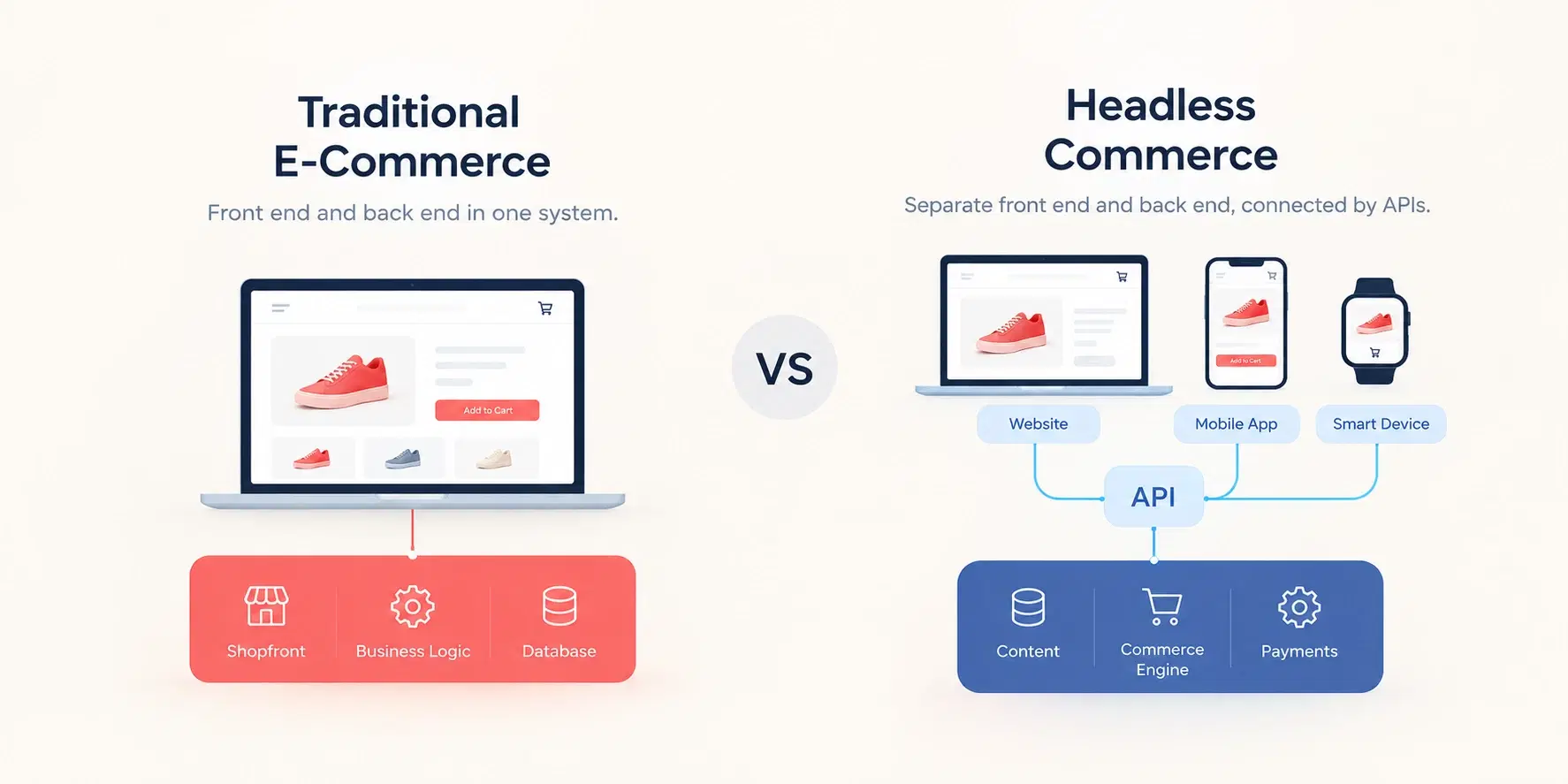
In definition, headless commerce means an e-commerce business platform architecture that separates the customer-facing front end (website, mobile app or a smart device) from the back-end commerce engine.
To put it simply: imagine your store in two parts; in the first one is the shopfront that customers see, and the second one is the engine behind it where products, pricing, orders, and payments all are. In the case of a headless commerce architecture, these two are separated and connected through APIs.
In practice, the front is free to evolve (redesigning the website or mobile app or adding new channels without touching anything else). One backend can feed all with the same catalogue and the same customer data.
This approach of modern headless commerce solutions in UAE businesses is being explored.
It includes:
Freedom in design (building the exact experience that customers are expecting)
Speed (a lightweight shopfront can load faster, which helps conversion smoothly)
Flexibility of channels (web, app, or marketplace) allows for shared access to the backend.
Faster experiments (teams can test new features and pages)
Key Note: Headless commerce solutions need skilled developers with careful planning. In this context, the headless commerce architecture requires a strategic decision from search to checkout to content.
What Is Traditional E-Commerce?
In the case of traditional e-commerce, it refers to the buying and selling of goods online while using a standardised web store, mobile apps, or a digital marketplace. Here, everything is kept in one package, from shopfront to order management, all taken in a single system.
Many businesses thrive in this environment due to the tight connections and rapid launch capabilities. But here’s the thing, as your business starts to grow, a change in the front end can damage the backend. In this context, customisation has its limits due to the template, and eventually something can eventually break.
Key Note: In this context, a custom ecommerce development in the UAE is valid because the modernisation of both headless and traditional architectures can be brought together. Some businesses modernise each part step by step, while others rebuild the shopfront of a traditional engine.
The Whole Picture: Headless and Traditional
Let’s look at how both headless and traditional e-commerce platforms work and give you an insight to make the decision in a clear and accurate way.

Key Note: Traditional e-commerce has lower complexity, and in the case of headless commerce architecture, the complexity is high. In this context, setting a customised AI e-commerce for UAE businesses is valid and essential. And before you make a decision, have a clear understanding of the below points:
Number of channels you sell today and how they will be after two years.
Site speed and design and how it makes limitations to conversions.
Do you have developers or a custom front end?
Plugins and workarounds and their cost.
If each of the factors is far stretched, you will be in need of a headless commerce architecture, and if not, a traditional one would be the best choice.
Starknox: Choosing Your Business Growth
Both headless and traditional e-commerce platforms are different in functionality. What is important is how the right architecture works along with the business idea and matches with your team, customers, and the growth landscape.
In this context, planning the right e-commerce development is important because customer experience is changing. That is why personalisation, smart recommendation, and AI-driven ecommerce development are becoming a part of conversion. Starknox fits right here with the right capability in making your brand platform ready and aligned with your customer and team. With the right structure and AI-driven development solutions, Starknox designs commerce platforms that fit with your business scale quite accurately.
Connect to the Starknox team and plan the right commerce setup for your business.
Frequently Asked Questions
How does AI ecommerce development in the UAE work with the existing platform?
The capabilities of AI, such as recommendations, chat support, and demand insights, can be added to the existing store when your platform has better performance and flexibility.
When should a business move to headless commerce?
When your current templates are limiting your design and the performance is affecting the overall conversion, it would be the best time to move into headless commerce.
Which business is suited for headless commerce?
Businesses with multiple channels, complex needs, and technical support are suitable for headless commerce to make it more efficiency-driven.